
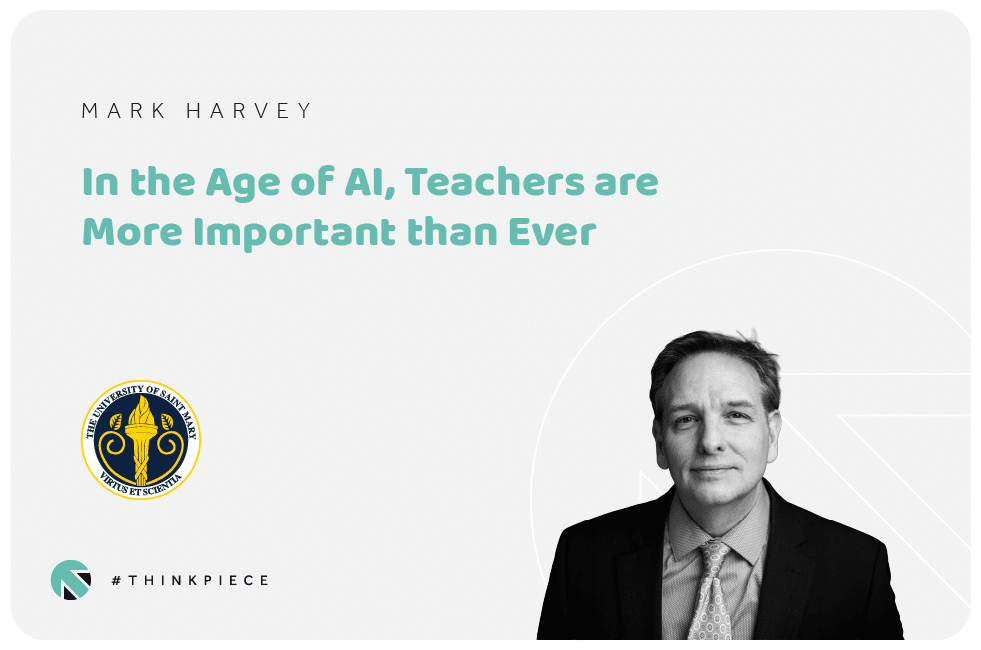
We are delighted to share this article by Mark Harvey, Professor and Director of Graduate Business Programs at University of Saint Mary. When AI burst into classrooms, many feared it would make teachers obsolete. Instead, in this article Mark argues the opposite: AI has exposed just how essential human expertise, judgement, and critical thinking really are. Drawing on real experiences with ChatGPT, Google AI, and university teaching, the author reveals the hidden flaws behind AI’s confident answers, from fabricated sources to misleading information, and explains why “AI literacy” without deep subject knowledge is a dangerous illusion. If AI is the clever intern, educators remain the expert mentors the future depends on.
In the Age of AI, Teachers are More Important than Ever
When ChatGPT was first released, panic spread across classrooms worldwide as educators feared that students would use AI to shortcut learning. And they did. How would already-stretched educators struggle to keep up? Soon, businesses integrated AI into their operations and began demanding AI‑literate graduates. Policymakers followed, asking what future‑ready skills should look like. Pressured by business use and student abuse, many started to wonder, how long will educators remain relevant?
As a business professor and a director of an MBA program, I am on the front lines of this question. I need to teach students how to use AI and then to teach instructors how to evaluate students’ use and misuse of AI. This, in turn, required me to figure out how to effectively use it myself. Over the course of this experience, I have come to a surprising conclusion. Unlike educators who fear that AI is about to make us redundant and will rob students of critical thinking, I have come to believe that AI has made teachers more important than ever.
AI Pitfalls and The Attention Span of a Goldfish
Because of my work on pedagogy and my ongoing integration of AI into master’s business programs, I was invited to give a few talks to faculty at different universities and organizations. I thought it would be funny to consult AI on my presentation, so I doubled down on the concept: I challenged AI to write a “meta” presentation for me, one that I could share with my audience and simultaneously deconstruct. In that way, I hoped to explore the ways that it could be helpful and discuss its limitations. I had a rough outline of the information I wanted to share. To frame the conversation, I used a Wizard of Oz theme, posing the question, “Should AI be revered like the mighty Oz or approached with caution as a possible charlatan?”
Based on the data and the theme, I asked ChatGPT to produce an outline for me. It did a reasonable job of organizing the ideas, and immediately offered to produce a PowerPoint with thematic images. Of course, I agreed. ChatGPT never produced the images it promised, and after much prodding, it eventually referred me to other AI platforms including Gamma, Canva, and Gemini. In general, all of the AI platforms I used often added unsolicited and incorrect information, failed to follow my directions, produced ridiculous images that incorporated nonsensical words, and sometimes failed to produce anything at all. Most of the time, AI promised more than it could deliver. I had to push it to correct flawed information and produce a quality presentation, and it never really got there. My conclusion was that I could have built a better presentation more efficiently without it.
On another occasion, I was preparing a presentation on student engagement for a faculty meeting. I wanted to emphasize the importance of being sensitive to students’ attention spans, so I sought data on the subject. As most students do, I started with a Google search. Google’s AI-enhanced search offered the first results, which at the time answered that “the average human attention span is about 8.25 seconds” and linked me to a study concluding that human attention span is shorter than that of a goldfish. Every link on the first results page referenced this study. I was dubious, so I followed up with this question: “Is average human attention span really less than a goldfish?” Google AI replied, “No, while the claim that humans have a shorter attention span than goldfish is commonly cited, research suggests it’s not entirely accurate…The idea…is a widespread myth.” That led to a link explaining how the “8.25 second” study had been debunked.
In both cases, the wizard behind the curtain proved unreliable, and challenging the bot was necessary to produce accurate data or improved outcomes. This is consistent with the “garbage in/garbage out” mantra that nearly every AI expert repeats at training and professional development events. In short, these experts argue that asking an AI bot “trash” questions lead to trash answers. This framing subtly shifts responsibility onto users, as if the technology’s shortcomings are simply user error. But even well‑crafted questions can yield false or misleading answers when the underlying data are flawed or the model is overconfident. If I ask an AI engine a clear question and it gives me a false answer, I should not have to challenge it with a follow up: “Are you sure?”
However, the openness of the internet and its inability to determine what is real is a huge limitation. Multiple sources have documented how government-sponsored actors have attempted to manipulate data by seeding false narratives for AI engines to perpetuate false information. I recently dealt with a course developer who used AI to write a syllabus that included invented sources and recommended readings from predatory journals.
Because many AI systems are optimized for user engagement, they often prioritize sounding helpful over being correct, creating a built‑in bias toward confident but inaccurate responses. This can also perpetuate bad information or frustration when bots over-promise what they can deliver. Students, professionals, and even educators should trust AI results at their own peril.
The Clever Intern Needs a Teacher: AI Literacy and Expertise
Despite my challenges, I remain optimistic about AI’s potential. At a recent conference, a presenter offered a helpful analogy. “When you use AI,” he said, “you should pretend you are working with a very bright, very ambitious, very enthusiastic intern. When you ask it to do something, it will do it very comprehensively and very quickly. But you may have to review its work, because it may not all be accurate or up to the quality you expect.” Thinking of AI in this way—as a student rather than an expert—is probably a healthier and more realistic way to incorporate the tool into your work.
My mantra to students learning AI is this: you have to be smarter than the AI. There is no AI literacy without subject‑matter expertise. You can’t evaluate an AI’s answer if you don’t understand the subject yourself. As an experienced educator and expert on educational games, I know what makes a good class and a good activity. I know what is accurate and what is not. If I ask AI to construct an active learning activity for me, I can see right away whether it will be effective.
However, this is a problem for students and even for many businesses that have blindly adopted the technology. If businesses lack adequate checks, they may damage their credibility. Likewise, many students do not have the skills to determine whether their finished product is faulty. If I have to wrestle with AI for good results, the match will be even more difficult for students—or they may blindly accept the results and pay the consequences.
In short, people cannot effectively use these instruments without expertise, and educators possess it. Thus, educators have two important roles. First, we must teach students how to properly and ethically use these tools. When teaching about AI, assignments should require students to not only produce something, but to describe the production and verification processes and the challenges experienced. In short, AI can be a tool to achieve higher-order learning levels on Bloom’s Taxonomy. Second, we must sell students on the importance of education. AI is an excellent tool, but using AI will not serve those students who cut corners. Those who gain expertise will avoid looking foolish and continue to differentiate themselves in the workplace. As AI becomes more integrated into education and industry, our greatest opportunity lies not in replacing expertise, but in elevating it—ensuring that future learners can work wisely, critically, and creatively with intelligent tools.
About the author. Dr. Mark Harvey is a Professor and Director of Graduate Business Programs at the University of Saint Mary. He is the author and editor of Simulations in the Political Science Classroom: Games without Frontiers, Beating the Clock: The Power of Short Games and Active Learning, and Celebrity Influence: Politics, Persuasion, and Issue-Based Advocacy.