
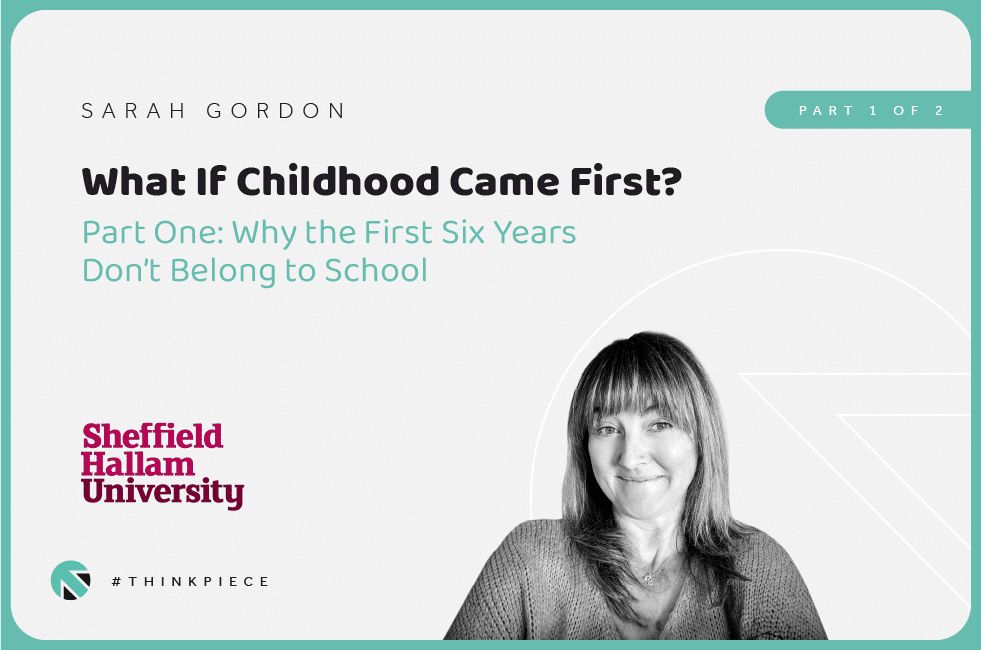
We are delighted to share a thinkpiece by Sarah Gordon, Senior Lecturer in Early Years Education at Sheffield Hallam University, following on from our recent roundtable discussion on the lived experience of early years and rethinking the conditions shaping school readiness in children, as part of our FED National Education Futures Projects on Inclusion. In this two-part series thinkpiece Sarah asks, what if the earliest years of life didn’t belong in “school” at all? This thought-provoking piece challenges the assumption that childhood must be shaped by formal education, arguing instead for a distinct 0–6 phase built around relationships, play, family support, and social justice. It’s a bold reimagining of early childhood, not as preparation for life, but as life itself, raising a powerful question: what kind of society do we create when we truly design for children, not systems? Read part 1 below.
What If Childhood Came First? Part One: Why the First Six Years Don’t Belong to School
I have spent most of my professional life in early years education, and over that time I was frequently encouraged to move into work with older children—framed as an “opportunity”, as though leaving early years constituted a reward.
Now, in a twist of irony, my role involves working with undergraduate and postgraduate students, helping them to understand both the wonder and the complexity of early childhood education.
During an Erasmus visit to Budapest, I observed a 0–6 phase operating in practice. In Hungary, the stated aim of kindergarten education is to foster children’s multifaceted, harmonious development; to support personality development; and to mitigate disadvantage—while taking account of age, individual characteristics, and diverse developmental stages, including those of children with special educational needs.
A question that has always plagued me since this visit – What if we took 0–6 out of “school”?
There’s a quiet assumption sitting at the heart of English education: that “school” is the natural home for childhood. We don’t often name it, because it feels like common sense. By four, many children are in Reception; by five it’s compulsory; and before that, early years provision increasingly mirrors school routines in miniature—targets, tracking, “school readiness”, timetables that train bodies to sit still before they’ve had time to be bodies.
But what if we dared to disrupt that assumption?
What if we treated birth-to-six not as the runway to formal schooling, but as a distinct public phase with its own goals, workforce, infrastructure and ethical commitments—separate from schools and protected from the gravitational pull of “standards”, “catch-up” and performative accountability?
This is not a nostalgic plea for a softer past. It’s a serious question about what early childhood is for, and about the kind of society that would invest in it properly.
The provocation: education is not always “school”
The UK is unusual in how early we begin formal schooling compared with many countries we like to benchmark ourselves against. In practice, England normalises a school start at four; and even where pedagogy in Reception is play-based, the institutional logic of school—uniformity, timetables, assessment, readiness—often reshapes what happens.
To ask whether 0–6 should sit outside schools is to ask a deeper question:
Should the earliest years be governed by the same purposes as later schooling?
Because the danger is not simply “too much phonics too soon” (though that matters). It is the broader risk that we treat children as future pupils rather than present humans; future workers rather than current citizens; future data points rather than embodied, relational beings.
Early childhood is not a preparation stage. It is a life stage. And if we honour that, we might stop trying to squeeze it into a school-shaped box.
What is truly needed from 0–6?
If we were designing a birth-to-six phase from first principles—based on what we know about development, inequality, family life and community wellbeing—what would we prioritise?
1. Attachment, emotional safety and relational continuity
Early learning is relational before it is instructional. Secure attachments and stable, responsive relationships are not “nice extras”; they are the foundation for language, self-regulation, curiosity and resilience.
Yet institutional pressures can push early years settings through routines and compliance and you can feel it in the language: “behaviour”, “readiness”, “settling”, “interventions”. Sometimes what is really being managed is not the child’s development, but the system’s anxiety.
A distinct 0–6 phase could centre continuity of care, small key-person teams, and time for relationships to deepen—rather than constantly “moving children on”.
2. Play as the serious business of early childhood
Play is not a break from learning. It is how young children think: through exploration, repetition, imitation, invention, negotiation, risk and joy.
When early years becomes “school-like”, play often survives as a scheduled activity rather than a governing principle. It is permitted, but not trusted. The adult gaze becomes evaluative: What did you learn? Can you evidence it? Can it be tracked?
A dedicated 0–6 phase could treat play not as a method but as a right and a language, supported by skilled adults who know how to extend thinking without colonising it.
3. Language-rich environments—without turning childhood into a programme
We should be unapologetic about language: stories, songs, conversation, vocabulary, multilingualism, narrative, listening, speaking. But there’s a difference between language as culture and language as compliance.
A 0–6 phase could support communication and literacy development in ways that are social, embodied and meaningful, resisting the temptation to fast-forward children into abstract formalism simply because the later system demands it.
4. Whole-family support as part of “education”
If we are honest, the biggest determinants of children’s early experiences are not in classrooms. They are in housing, income security, parental mental health, community safety, accessible healthcare and the availability of time.
A genuine early childhood phase would treat family support as core business: parenting support without stigma, access to speech and language services, SEND identification and support that doesn’t require parents to fight, community health links, and spaces where families feel held rather than judged.
This is the radical move: to recognise that early childhood education is inseparable from public health and social justice.
5. The right workforce—valued, paid, developed
You cannot build a high-quality 0–6 phase on precarious wages and low status. England’s early years workforce has long been asked to deliver increasingly complex work under increasingly fragile conditions.
If we take 0–6 seriously, we must treat early years educators as the specialists they are: with pay parity pathways, funded training, manageable ratios, time for professional reflection, and career structures that don’t require people to leave early childhood to be respected. A phase outside schools could also protect early years pedagogy from being treated as a junior version of “real teaching”.